Saturday, July 29, 2006

Zupport for Zavandor


Mike Siggins's new Notebook is up.

Favorable review for Das Zepter, which makes me feel a lot more secure in my decision to order it despite its being an indy game (Lookout Games, Jens Drogemuller) that has a reputation for running too long. I have to admit, it was the theme that tipped me over the edge here. A fantasy-flavored system game? I'm there, and I'm sure my game group will be happily predisposed to giving it a shot.

All I have to do is call it "The Rod of Seven Parts".

Sunday, July 16, 2006

Toys 'R (Finally?) Us


The first TRU store in the country (ever?) finally opened in one of the city's malls a few weeks ago. I finally got to go check it out. I didn't have a lot of expectations, boardgame-wise, but did hope that some of the more common stuff would be there at somewhat reasonable prices.

The store is small by TRU standards. It's smaller than the two TRU stores in Singapore that I've had the chance to visit. The display that greets you at the entrance is a large Pirates of the Carribean: Dead Man's Chest tableau. I immediately go looking for the only item that might interest me - Pirates Dice.

Nope, not available. Dammit.

I can see the large stack of Monopoly Manila edition a couple of aisles down and make a beeline for the boardgame section. Ooh, Game of Life. Ooh, Trouble. Wow, bunches of chessboards.

Whoopee.

Interestingly, the party games are very sparse. I see several Charades variants (no Time's Up of course). I went looking for Electronic Catchphrase, which I would have picked up had it been there.

Nope, not available. Dammit.

Along with scads of Battleship and Clue and Monopoly Basic Edition and a hundred UNO-brand games were a few boxes of Heroscape Master Set and one of the expansions. Not interested in that (there's a reason that it's a children's game), so that was it for the boardgame section.

Disappointed, I walked through the rest of the store, pausing at the videogame section just because they had some iPods and iPod accessories. Nothing unusual that I couldn't get cheaper elsewhere. So I turned around to leave when something caught my eye.

I could spot the box cover of Vegas Showdown on a shelf across from the action figures section.

This part of the store has a small selection of CCGs and CMGs. I was about to make a remark to the staffers that most of the Wizkids products on display were now unsupported, but thought better of it and instead focused on the boardgames.

There was a small selection of FFG, Hasbro and Eagle Games from the local distributor. Descent and Twilight Imperium III were US$100 each. Good luck selling those things. Vegas Showdown, Sword and Skull, Monsters Ravage America and Nexus Opes were around US$50. Still Ouch. Tsuro? US$50. Doom? US$65. Ingenious or Beowulf, which I was actually interested in picking up?

Nope, not available. Dammit.

So much for that.

I threaded my way past the Disney section, the Barbie section and even more Pirates to the exit.

One last check for Pirates Dice...

Nope, not available. Dammit.

Sunday, July 09, 2006

Divining Descent: Journeys in the Dark

Photobucket - Video and Image Hosting

What is it?

Descent: Journeys in the Dark is a boardgame. Designed by Kevin Wilson for Fantasy Flight Games, it's a tactical combat game in a fantasy setting. The main activity is combat. Two to four players each take a character (or characters), ideally forming a team, and explore rooms and passageways. Their opponents are various fantastic critters controlled by another player. Essentially, it's kill or be killed all the way.

What is it NOT?

It's not a roleplaying game. It's also not a Eurogame. Descent is more of a videogame adaptation, since characters cannot die (the adventuring side just loses victory points) and the "overlord" player has an unlimited amount of creatures that theoretically can appear anywhere. It's also not very variable. Descent is a series of endless battles until the victory point condition is met by either side. Characters either hack away with melee weapons, shoot with missile weapons, or utilize "magical" attacks.

What do you get?

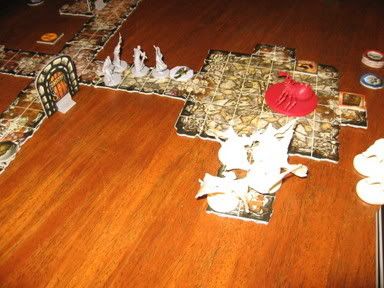
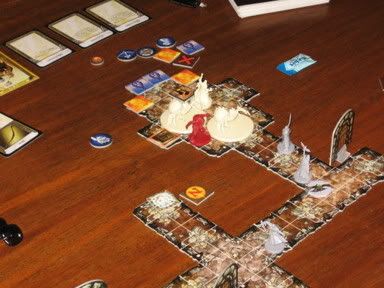
A huge box filled mostly with miniature unpainted plastic figures. The game also has cardboard tiles, cards, and a lot of counters. Overall, the production is very well done, as you might expect from Fantasy Flight.

What did you like?

The combat system is interesting. (I never played its predecessor, DOOM: The Boardgame so it's new to me.) The odds of success in attacks and the amount of damage dealt are driven by various colored six-sided dice. The type of attack and the weapon utilized determine which and how many dice are rolled. Damage is soaked by armor. Various status effects apply. The system isn't a bad approximation of what many similarly-themed videogames present.
Photobucket - Video and Image Hosting

What could have been done better?

Descent is a long game. Given the system, it's unavoidable since there is no "downtime" for the players unless they leave the dungeon premises and teleport to the town. If they do that, they're no closer to winning the game. There is also very little story here - it would have been nice to have more reasons for things in the game, especially since Descent is purely an experience game. There is no pretense towards balance anyway, so why not lean completely on the theme so that it's easier to overlook the various problematic game elements?

Related to the theme thing - the way the Overlord plays completely breaks the theme. Monsters coordinate perfectly, as if being driven by a hive mind. That makes no sense. They also can use knowledge that they thematically don't have, just because the Overlord player has the game information.

Finally, to beat a dead horse - the treasure rules make no sense at all. Character have to be adjacent to pass items, but treasure from the chest teleports to the characters? And there are always magic items equal to the number of players?

Recommendations

Descent is an MMO "RPG" translated to board game form. As you might expect, it's a lot slower than its computer kin, it's got a lot of moving parts and it makes less sense because of the lack of story. If you shun MMOs and need your fantasy tactical combat fix, give it a try. Otherwise you're probably better off playing a similar game online.

If you're looking for a true roleplaying game, you won't find it here either. It's just a game. There are no roles, and no story to speak of.

If you're after a lot of plastic fantasy figures to paint, you're in luck. Descent has a lot of plastic figures.

Eurogamers, there's no balance and a lot of randomness here. Roleplayers, there's no story or logical structure to the in-game behavior of the elements. Heroquest fans, this is right up your alley. MMO fans, if you for some reason want to get off the net and play with plastic, this is also right up your alley.
Photobucket - Video and Image Hosting

Personal Spin

Not for me, but I would play if asked by my game group and there's no one else available. I would consent to playing the Overlord, but would inject reasonable monster knowledge and intellect into the proceedings. I'd also probably choose to not spawn in cleared areas, because that makes no sense. Considering the time investment and the lack of a compelling hook, I don't look forward to the next play at all and will probably never ask for Descent to be played again.

Ratings

My rating for Descent: Journeys in the Dark: 4/10
Current Boardgamegeek rating: 7.2/10

Wednesday, May 31, 2006

Broken

I knew it was a bad idea to use a .css file that was hosted on a site other than Blogger. So I converted two of my weblogs over to templated from googlepages.com because I liked how it all looked. Now, that site has exceeded its bandwidth and so it stopped serving the .css file. It took a week to figure it out.

Oh well. So back to one of the standard Blogger templates until a better idea surfaces.

Ah, the distractions from publishing actual blog posts that people want to read... :(

Friday, May 26, 2006

Spoiled by Elegance

Chris Farrell says exactly how I feel about Caylus here. The key excerpt:

Maybe I would have gotten a kick out of [Caylus] 15 years ago, before I played Adel Verpflichtet, Modern Art, or Settlers of Catan, but today I crave something artful, something well-crafted, and something that is actually fun. And something that provides the intellectual and psychological challenge without making me do this much gratuitous, and fairly boring, work.
Now, what is "fun" is completely subjective. I think this undeservedly-ignored Geeklist "The Qualities of Fun" be Stephen Avery says it quite well (I was going to do a similar one but it would have been redundant when I found Stephen's offering.) Chris and I may share a sensitivity (although perhaps to a different degree - he's played far more boardgame than I have) to rough edges.

Caylus: Chris - 4, Rick -4
Power Grid: Chris - 6.5, Rick - 6
Age of Steam: Chris - 7, Rick - 5
War of the Ring; Chris - 6, Rick - 3
Reef Encounter: Chris - 8, Rick - 4


I can't speak for Chris other than to divine his thoughts from the quote above. The term I usually use in this instance is the much-maligned term "elegance." I take games in a wholistic sense - does the game work as a unified whole? Is there no wasted space? Are players given just enough freedom to know that they have control over their destinies, but not so much control that the game slows to a crawl?

Single elements of games don't tend to do much for me in terms of making up for less-than-stellar gameplay, just as much as a glaring weakness in my eyes will make a game intolerable. It all has to mesh.

For example, Wallenstein's cube tower is an element that a lot of people enjoy. To me, it's one of the worst resolution mechanisms in all of gaming. It's more annoying than Settlers of Catan's 2d6 production roll and The Game of Life's spinner. I can at the very least calculate odds on those two. There's no calculating the odds of a cube stuck in the tower coming out in a particular battle, or the odds of a cube thrown in getting stuck in there. Add in the thematic break of an army unit fighting on one end of the country teleporting to a battle on the other side of the country and you have a mechanism that I cannot enjoy.


Over to theme. Say what you will about "pasted on" themes, but a game's theme either works on that abstracted level (Knizia's Samurai, Torres, Amun-Re, Euphrat & Tigris) or it doesn't (RA, Medici, Beowulf, Cartagena). To me the more disappointing ones are the near misses like Wally, which would have been a more tolerable area-control/Eurowargame if it had used dice or cards for resolution instead of the gimmicky tower. I cannot tolerate games that are all flash and no substance, games that commit far more heinous crimes to my game sensibilities than Wally.


So, an "elegant" game in my book has streamlined mechanisms and a theme that's integrative but not necessarily all-encompassing. Caylus has neither. Similar to Chris, I feel that it's got a lot of mechanisms that don't necessarily add to the game, and its theme is breached in some places. (On the latter part I'm most bothered by the Provost and the Bailiff. They just don't make sense in the context of the theme.)

So I guess I've been spoiled by Knizia and Kramer and Dorn who consistently produce games that meet my criteria of "elegance." That doesn't mean other games will not be enjoyed by the boardgaming community. They just won't be enjoyed by people with game tastes similar to mine.

Tuesday, May 23, 2006

THE MYSTERIOUS GAME OF MYSTERY (tm)

From the exchange of emails between myself, Joe Gola and Gil Hova:

Joe, March 16:

I'm planning to bring Clash of the Gladiators and at least one or two other recent releases just in case. I tend to change my mind a lot at the last minute, though, so I may show up with something totally random. HOWEVER if fortune smiles upon me and a certain package shows up tomorrow or Saturday morning I'll have something VERY new and exciting to bring.


Joe, March 17:

The ones I'm particularly enthusiastic about are Merchants of Amsterdam and Tower of Babel, and if both of you guys are interested in Atlantic Star, then I'm fired up to play that one as well. Naturally I'm also very excited about the MYSTERIOUS GAME OF MYSTERY.


Joe, March 18:

By the way, the MYSTERIOUS GAME OF MYSTERY has ARRIVED! It is (supposedly) sitting at my house right now. I may have to leave work early.

Just to tantalize you further I will let you know that the MYSTERIOUS GAME OF MYSTERY is a brand-new big-box Nuremburg game from a very well-known designer and a very well-known publisher. Two of the previous collaborations between this designer and publisher are in the BGG top 50. The game only just became available in the U.S. two days ago and has less than ten plays recorded on BGG, so to say that we will be on the "cutting edge" when we break this out this tomorrow will be completely accurate.

And it's not Celtica.


Rick, March 18:

Dammit I was guessing Celtica!

Maybe either Blue Moon City or Bison or Thurn & Taxis?

Damn you Joe for making me look for the MYSTERIOUS GAME OF MYSTERY.


Gil, March 18:

All the games sound great; I don't think I'll bring
any of my own, in fact. We should have plenty to do
with what's already been mentioned.


Rick, March 18:

G'night and see you both tomorrow!


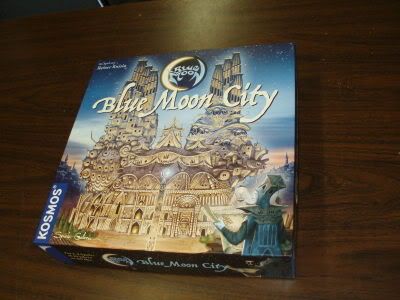
1. My first guess (after Celtica) was correct. THE MYSTERIOUS GAME OF MYSTERY (tm) was:

Photobucket - Video and Image Hosting

2. Gil lied. He did bring a good-sized bunch of games, including THE PROTOTYPE WE SHALL NOT SPEAK OF which we played!

3. That was a very good day of Quizno's subs and gaming. I wish Quizno's would franchise out to this corner of the world.

Over to the next post.

SNAFU and Haz

Thanks to "Mr. ekted" Jim C., I noticed that the template of this weblog broke for some reason. It took a bit of time to reconstruct the template, so the promised post will have to wait until tomorrow.

Just to have a bit of game-related content on here, we finally got to play some (Ha Ha) Hacienda (or plain Haz to us) over the past few weeks. It's not Wolfie's greatest game ever (that's good ol' 555), but it meshes a lot of game mechanisms into a nice package. The ones that ususally stand out to gamers are the card drafting mechanism (popularly attributed to The Moonie) and the "score points by connecting to an adjacent hex" thing used by Reiner in Through the Sausage. Honestly, it's nothing like Zug um Zug or Durch die Wuste.

Haz has an economic engine that's powered, interestingly, by the game's spatial element. You get money based on contiguous tile sets. There's no virtuous or vicious cycle here. It a novel way to get around the rich-get-richer characteristic that most economic models in games possess.

I'll revisit Haz with a proper review in the future. For the moment, color me satisfied. (BGG Rating: 7/10)

Sunday, May 21, 2006

Yes, I've Been Away

I've been away in several ways. I was away physically, being in three different countries over the course of two weeks. I was away mentally, with the jet lag killing all semblance of a routine and events forcing me to play catch-up with my own sense of equilibrium. I've also been away spiritually, choosing to give some of my life to other pursuits in the interim. There was no weblogging for about ten weeks. There was a lot of time with my family and friends and other hobbies. There was some vacation and travel and beachbumming and walking around in the rain.

And yes, there was some game playing. We'll get back to talking about games in the next post, now that my fingers have gotten reacquainted with the feel of writing with the electronic pen again.

I've tossed out the piece I did on the fateful convergence of myself, Gil Hova and Joe Gola. I didn't like it. During the time away I guess I got in touch with the artist squirreled away in the recesses of my brain, and he thought that my writing (especially my game-oriented writing) was tremendously boring.

Joe did this. Gil did that. Rick scored this many points. Joe laughed. Gil gestured. Rick won. Pah. Boring. Deleted.

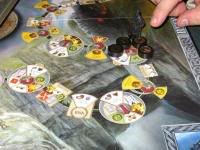
Granted, rewriting the story of The Day We Played the MYSTERIOUS GAME OF MYSTERY (tm) from my fading ten-week-old memory will be a challenge. It's a good bet that I won't remember any details about where Joe moved his silly Blue Moon token, or how many points I scored when playing Gil's prototype, or how strange we thought Rotundo's theme was. What I DO hope is that the things I remember will remain interesting for myself to write, and for those few patient readers of this weblog to read.

It's coming up within the next 24 hours.

Monday, March 20, 2006

LudoNJ 3-Way

After some touch and go moments I got to hook up with Gil Hova and Joe
Golazeski for some gaming in the hinterlands of New Jersey. Thanks to Gil
for driving down to my hotel and giving me a ride!

Joe had been hinting that he would have a new gae for us to try, the
MYSTERIOUS GAME OF MYSTERY. The clue was that the game was fresh off
Nuremberg, by a well-known designer and from a well-known publisher. That
combo had two games in the BGG top 50, and it wasn't Celtica. (I got it in
one guess.)

I'll run a session report when I get back to Manila. We played 5 games,
including Gil's word game prototype, in about 6 hours.

Sunday, March 12, 2006

The "Big" Order

Well, I'm sitting in my hotel room in Jersey. I'm still a bit woozy from turning my body clock around. It's 8:30am here, but it's 9:30 back home and my system is still insisting that I get ready to head to bed.

Anyway, I just sent off an order to Fair Play Games as recommended by Mr. Joe Gola. I hope this goes off without a hitch. On their website they estimate 2-3 days to deliver to the East. Assuming they get the shipment off by tomorrow, I should expect the games to arrive by Friday. This also marks the first time I've ever put my credit card information online, ever. I'm just ultra-wary of credit card information theft on the web. And here I am risking it all for a bunch of boardgames. It's an unhealthy fixation, I tell you.

Anyway, as I've written before my wishlist is woefully thin at the moment. I augmented my order with a bunch of R&R party games which cannot be had in Manila. Sometime, a good party game is what we're in the mood for and you can only play so much Cranium. Besides, Snoop Glenn's new "You Must Be an Idiot!" is intriguing to me.

So, this is what I ordered:

Hacienda $24.45
Merchants of Amsterdam $27.95
Meuterer $8.45
Power Grid Expansion : France & Italy $10.55
3 Puerto Rico Expansion $10.35
Sticheln $8.45
Thingamajig $13.95
Tichu $7.95
Time's Up $14.45
Time's Up Expansion 1 $6.95
Time's Up Expansion 2 $6.95
You Must Be An Idiot! $13.95
Sub total : $154.40
Shipping - United States - UPS : $0.00
Total : $154.40

Thanks to Tom and Joe at The Dice Tower, I had the discount code for free shipping for an order > $150. I was just short so I tossed in a copy of Tichu even though it's likely that I'll never get that to the table, ever.

If the games arrive by Friday I'll have something to bring along if the rendezvous with the Hovas and Gola (wow that rhymes) happens.

Off to NJ

Just a quick post - I'm sitting on Northest flight 20 headed for Minneapolis then on to Newark. It's a business trip, but it looks like the stars will align and I'll get to meet Gil "ingredient X" Hova, Heather "guenlian" Hova and the most esteemed Joe Gola.

Pardon the format if it's screwy, I'm doing from from a Blackberry and the results have been unpredictable.

Next post will be from NJ!

Wednesday, March 01, 2006

Of Killer Bunnies and Beer Money

I've played Killer Bunnies exactly once, and that was enough for me. I've never played Beer Money, but the description of the game convinced me that it wasn't for me either. Apparently, I'm supposed to imbibe large amounts of alcohol before even attempting to play.

I listen to a really fun podcast from The Dragon Page called Wingin' It where the crew led by Michael R. Mennenga and Evo Terra drink beer and talk about... well, practically anything. It's usually somewhere in the genre universe of science (speculative?) fiction and fantasy and it's almost always funny. Anyway, the folks on the podcast are sometime (casual) gamers, and lately Evo's been on a Killer Bunnies kick ever since some bloke from Australia named Phil visited their studio in Phoenix and introduced them to the game.

As a person who would never willingly play Killer Bunnies ever again, I'm fascinated by the way they talk about it. They're passionate. Excited. Pumped. And they're ready to play Killer Bunnies right. this. second. After drinking some beer. In the referenced show, the people on the cast talk a bit about some of the games that many of the Euro or War game crowd probably wouldn't touch with a 10-foot meeple.

I mention all of this because of this thread on Boardgamegeek disparaging party games, of which Killer Bunnies and Beer Money are a subset of, if not in form, then certainly in spirit. People seem to forget that we play games because they're interesting or fun. Moreover, we play boardgames and cardgames instead of computer games or online games because of the PEOPLE. Even if you're playing the biggest baddest multiplayer brainburner on the planet, you've still got other people sitting at the table around you. So what if they want to play Killer Bunnies or Cranium or Taboo? Suck it up and play, or sit out and shut up. But don't complain that they're stupid or retarded or uneducated. That just proves that YOU are stupid, retarded and uneducated.

Listen to the people playing. Are they having fun? You're not having fun? You're the problem, not them. You need to find people who like the same stuff as you if you're unable or unwilling to suck it up and just enjoy the company of other human beings. Or, maybe you can imbibe some Arrogant Bastard and that'll loosen up your clenched ass enough to have fun. It doesn't always have to have anything to do with what game you're playing.

Sunday, February 26, 2006

Free Parking, or Why We Don't Do House Rules

Image hosting by Photobucket

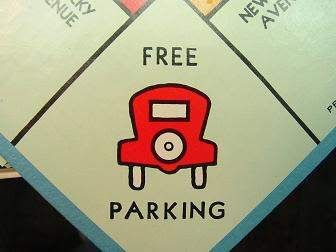
If there's one game mechanism that can show us why house rules, or not playing but a game's published rules, is something to avoid, it's Free Parking.

Free Parking jackpot, which usually consists of an initial stake plus collection of fines and taxes that would otherwise be paid to the bank. A player who lands on Free Parking wins the jackpot, which may then be reset with the initial stake (if any). The jackpot is usually put in the center of the board. (Wikipedia.org, Monopoly House Rules)

Thus it mystifies me when I read many posts of gamers modifying game rules due to perceived imperfections in the original design. Essentially, they are creating their own Free Parking problem. House rules are fine if the same group of players confine themselves to playing with each other. I'm sure that there are gaming groups where this is the case.

However, when gamers start playing with (or even worse TEACHING the game to) people from other gaming groups, then the house rules become a problem. It becomes easy to forget the correct published rules when you are used to playing with house rules.

Say, your group has decided that you don't want to deal with memory and therefore always play Euphrat & Tigris with open scoring. You then teach the game to a cousin from out of town, who then buys his own copy and takes it back home. He then teaches the game to his own friends with the same open scoring rules error. It is in this way that Free Parking comes to Mesopotamia. When these players go out and play with others, they are surprised to learn that they have been taught Euphrat & Tigris incorrectly.

It is understandable that gamers try to take a game that they found uninteresting or borken and try to salvage their investment by tweaking the rules. Perhaps it would be better to simply take the offending game and sell or trade it. There are many games that work very well out of the box. Why dignify a crappy game by devoting even more time trying to fix it, and then playing the same crappy game again in the hope that the fix improved gameplay? Sell or trade it for a game that you know works. Boardgamegeek is a good place to see if a game you have your eye on has any problems.

On a final note, companies are exhibiting an increasingly alarming tendency to issue games with poorly-written rules. Whether this is a result of poor translation from a foreign language or simply having a poor rules writer AND editor is irrelevant. Companies then try to correct this problem by issuing errata or "official variants". ("Official variant" is a term that is horrible and laughable at the same time.) A recent and very amusing example is the recent release of the new edition of Britannia, which had its "FAQ and errata" released one day (Feb 23) after the game (Feb 22). That's just pathetic from a consumer standpoint. There is clearly very little focus on quality in this case.

There are apologists who say that this kind of thing is expected and should be tolerated. Bullshit. What happens to the people who buy the game but never access the internet? They're stuck with a product that's flawed or even broken such as Avalon Hill's Betrayal at House on the Hill. The publisher's product contains house rules (since the rules are incorrect and/or incomplete) as produced, and the correct way to play the game is issued as a fix. We've already given up on holding software companies to standards of high quality, accepting that all software will have patches, bugfixes or service packs just to get them to work as advertised. Let's not do the same thing with publishers or any other companies that produce flawed products.

Let's not pay for Free Parking.

Saturday, February 25, 2006

Memory

Image hosting by Photobucket
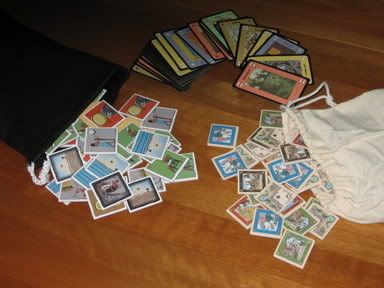
One of the unending debates in games is whether memory is a valid skill. I've always found this argument silly.

The people against memory usually invoke the term "trackable information" as an argument against memory. Essentially, if you can take pen and paper and take notes on (usually random) elements of a game in order to keep track of what has appeared and what hasn't, then that information should be open. A good example of this is RA's random tile draw. The initial tile distribution is random, so if you have a tracking sheet and tick off each tile as it appears, then you should have an exact inventory of what remains in the bag.

A closely related argument to this is "countable information" wherein all the game elements are out in the open except for one, and that hidden element can be determined by counting known elements and calculating. For example, the number of caballeros in El Grande's castillo, or the amount of cash each person has in Power Grid are examples of countable information. Countable information is always also trackable.

Now, I don't know if the people who want to keep this information out in the open are just bad at remembering things, so they don't want to be disadvantaged. Memory is a valid gaming ability, just as spatial reasoning or strategic brilliance or mathematical ability or word association or a vast reserve of trivia in your head. Is memory just as valid a source of competitive advantage as the ability to think four moves ahead or the ability to crunch numbers in your head accurately? Of course it is.

For example, if Karl-Heinz Schmiel wanted all players in a game of Die Macher to always know how much money each party had at any time, he would have either built it into his game mechanisms or components, or mentioned in the rules that players should keep track of everyone's cash with pen and paper. (Note that Die Macher is a game where you already need pen and paper for scoring and bidding. Money in this game is trackable information.) Therefore we can infer that Schmiel wanted players who can keep track of money in their head to have some advantage in bidding for the Opinion Polls, especially in the final election. You make that information freely avaialble to all players, and you remove a source of competitive advantage from the player with good memory that is granted to him by the game rules.

Unless the rules explicitly state that players should keep track of something with pen and paper, it is assumed that either players use their memory to maintain count or recount the game elements on the board when necessary. I know that many groups hate it when someone starts counting caballeros in order to determine how many of them are in the castillo. However, this is part of the game and is therefore part of the design. If you play El Grande, you get to count the caballeros anytime you damned well please. (This is one of a few reasons I'm not enamored of El Grande.)

If you insist on playing a game against the rules (like the very silly house rule to use open scoring in Euphrat & Tigris) then you are playing a variant that eliminates an important game element - memory. You (and your gaming group) might all agre to play it that way. That's fine. Just be aware that you're applying a variant house rule that tinkers with the way the game was designed, and are therefore playing a different game than the rest of us who play with the rules as published.

Friday, February 24, 2006

Simultaneous Action Selection, Bluffing and Other Mechanisms of Little "Skill"


Geeks love these kinds of discussions.

Jim over at The Gamer's Mind talked about Simultaneous Action Selection and randomness.

Thi Nguyen picked it up and made a counter-argument in Geeklist form.

I'm not really interested directly in the debate here, although it IS excellent reading for the hardcore gamer. I'm more interested in the use of the word "skill" within that discussion.

What follows here is my personal interpretation of the arguments in the articles preceding.

People seem to define "skill" as a game element where players' decisions have a meaningful impact. I.e., making a deliberate decision based on available information should give the player a better game result. So, this opens a different yet not-less-significant can of worms.

First: If a decision is based on pure conjecture, is it skill? Is "reading" your opponents a valid "skill"? Some, especially poker players, will argue this to be true.

Second: If a player makes a decision based on statistical probabilities, is there skill involved? The Rock-Paper-Scissors example cited in Thi's list is a simple example here. Now, if in the counter-example in the same list where you have "Good ol' Rock" Bart Simpson likely to pick Rock, a player (Lisa) makes decisions based on THAT assumption, it becomes "reading" the opponent OR using preacquired information. Is that skill? Is there skill involved in (a) knowing Bart picks Rock a lot and (b) therefore playing Paper more often than you otherwise would?

Third: If a player makes a decision based on perceived outcomes that he attempted to influence, but where he is uncertain of the outcome of his influence -i.e., Diplomacy - is this skill? Is a player who is backstabbed more often a player of less skill?

Fourth: I'm adding this as an afterthought. Are decisions based on historical information "skill"? This is part of the Simpson idea in the second item, where Lisa has information on Bart's tendencies when playing Rock-Paper-Scissors. It's also one of the "skills" poker players tend to cite - knowing how other players play. This explicitly means you are using "metagame" information - information obtained outside of the current game.

In all four cases, I would argue that there is no skill, as I define it. The reason is that the decisions a player makes is based purely on conjecture, or on information coming from outside of the current game. I would call this making decisions based on "peripheral information". This information is not coming directly from the game, but from the players. Is this part of the game? Maybe, but I would disagree. I *might* even call it cheating to an extent.

It's like playing poker on the internet. The only information you have is the amount of the bids and the bidding pattern. Poker players tend to not consider this as "real" poker because they lose the peripheral information they get from physical cues. Anyone can count cards when playing online with the use of pen and paper. So all you have now is the bidding, which is essentially how one bluffs. Without peripheral information, it's not much use game mechanism-wise. So the game of poker, without the peripheral information, is barely more skillful than blackjack.

Yes, yes, some gamers will call this "interaction". Any game has that. Even a game like Puerto Rico contains these elements. If I know that Billy prefers the corn strategy and he's sitting on my right, I can use that information in decision-making. If I know that Mary always bids in increments of five in Modern Art, I can use that information too. And if I know that Gerald is a pathological liar in Diplomacy, I'll play as if he's gonna backstab me every damned time.

Is that "skill"?

No, it's not. The ability to take current game information and only current game information and make a meaningful decision based on that - now THAT is skill. You MUST remove any peripheral information, such as historical preferences of the other players, from the mix. Decisions based on probabilities - my goldfish can do that. "Princess Bride" decisions also identify game mechanisms where skill in not involved. Same thing with "bluffing".

So you poker players out there - you're playing a game that requires very little skill.

Monday, February 20, 2006

New Look. New Name?

I just updated the weblog template, swtiching out one of the built-in Blogger looks for this style named "Beckett" courtesy of Blogger Templates. Let me know if it's an improvement or if I made a horrid mistake! (Those of you reading via an aggregator might want to surf over just to have a look.)

Also, taking a cue from my buddy Jim I'm considering changing this weblog's name. "Rick's Boardgame Blog" is descriptive, but not terribly catchy. (And there are a lot of Ricks out there.)

If you've got any suggestions, feel free to post it in the comments or email me at dreamNOSPAMweaver7@gmail.com. (Take out the NOSPAM of course.) If I use your suggestion I'll give you due credit, and 5 shiny Geekgold if you're a BGG denizen.

Sunday, February 19, 2006

No Games Played, and No Good Fantasy Quest Games

I showed up at the Lily Pad on game night to find George down with a bug. She wasn't feeling all that bad, but it was deemed best that she lie down and recover. Three others also either sent regrets or cancelled, so it was just the two of us. I did have YINSH and TAMSK with me, but in the end we decided that for a change we'd watch a film.

I'd just acquired the DVD of the film Mirrormask. It's an interesting story of twisted dark fantasy from the minds of Sandman collaborators Neil Gaiman and Dave McKean. If that sounds interesting to you I put up a review on my film weblog, The Silver Screener. (I'm also reviewing all the Academy Awards Best Picture nominees.)

While viewing the film we did lament that there are no good fantasy quest games available. Good is relative, yes, but the ones we've tried have never garnered enough interest for a second look. Heroquest, Runebound, Return of the Heroes, Dragonhunt, Magic Realm - all either took too long, didn't provide enough flexibility, or required a player to be the "dungeon master". I suppose if you classify Reiner Knizia's The Lord of the Rings boardgame as a fantasy quest game (and why the heck not) then that would be the best fantasy game we've ever played.

I suppose our standards are just too high after growing up with AD&D and having some amazing game masters among our group.

Anyway. Hopefully back to Eurogames next week. I'll have to tide myself over with games on Spiel by Web, which just launched Tikal, and the new MaBiWeb, which debuts with Hansa and Richelieu.

Tuesday, February 14, 2006

And I thought I was a curmudgeon...

Check out the Knizia-hating Geeklist by BGG user MichaelB. (I don't usually read Geeklists any more but a comment linked to the list from Jim off of my Geekbuddy list.)

I know I just ranted on low-utility plastic figures. I think I had good cause.

Conversely, I wonder why this guy plays games at all.

1. He hates randomness (E&T and RA tile draws).
2. He hates Taj's bits: the plastic palaces and their colors. While color is entirely subjective, the palaces are simple and nicely done. Cheap? So he hates plastic.
3. On Amun-Re: "Everything is great in this game but it just feels mediocre... " You're calling the game great and mediocre in the same sentence?
4. Samurai is "not as fun as it should be". Huh?
5. Lost Cities is "too light even for a filler". Duh. I wonder what his idea of a filler is. And I do not think "rip-off" means what he thinks it means.
6. TtD has "silly components and stupid colors". I love the comment "what is a stupid color"?

Amusingly, his Top 10 include Age of Steam (random production rolls, very cheap bits), Conquest of the Empire (plastic bits that are no better than Taj Mahal's palaces), Age of Mythology (more plastic bits, and a mess of a combat system that's more random than tiles could ever be) and Mare Nostrum (simply a mess of a game due to the map balance and crazy trading).

I'm not picking on the guy. I'm just noting that despite nitpicking on certain games and game elements, I enjoy playing games and don't rag on them just for fun. Vasel knocked Farrell for this in one of his recent podcasts, which was completely unfair and unfounded. Farrell has a staggering 42 '10's and 48 '9's which is far more than Tom does, so saying "why does he even play games" is uninformed. I don't expect journalistic responsibility from the boys in Korea, but they could at least do a little checking instead of shooting from the hip based on the negative stuff written on games they like.

Saturday, February 11, 2006

The Case Against Plastic

You've got your 'old school' chits-and-counters on one side of this theoretical spectrum, and plastic toy soldiers on the other. I'd place your common Eurogame wooden pieces somewhere between those extremes.

Bits. They can make your game look a lot better than it is, or make a good game look like crap. They can work well, or be tremendously annoying during play. They can also be completely useless.

There's been a trend lately, led by Eagle Games (okay, they've been doing this for a while), Fantasy Flight Games, and good ol' Hasborg (fine, they've been doing it for a while too) to stuff as many plastic figures into a game box as possible. The function of this practice is pretty clear - appeal to the Army Men toy gene inside male gamers to entice them to buy a game. For the longest time Eagle did this a lot, with mediocre games like War! Age of Imperialism, Attack! (before the expansion) and Age of Mythology sporting lots of cool plastic figs adorning games that leave much to be desired. Hasborg never really stopped, most recently releasing THE game for young boys to have these days, Heroscape. Finally, FFG has Chinese factories churning our prodigious amounts of plastic figures to stuff into their "epic box" games - Twilight Imperium 3E, World of Warcraft and Descent: Journeys in the Dark, and the less-than-epic-yet-still-plastic-choked Doom. FFG also did the stateside release for Nexus Editrice's War of the Ring, no pushover in the plastic wars itself.

So, what do all of those games have in common?

The plastic pieces have little to do with the game itself. They're purely eye candy and have no impact on the mechanisms. They don't even carry any game information outside of whatever unit they represent. In some cases, the units are even functionally identical despite looking different.

I think that's just silly from a gameplay standpoint. Of course, to some marketing to the eyes is more important than actual gameplay, so you have the games presented as above.

Forget for a moment that I hate War of the Ring's mechanisms. Even if the mechanisms were good (say, Hannibal good) I still would have been unable to get past the tremendously annoying figures that not only choked up all of the board real estate, but were functionally identical. The physical attributes, the decision to use plastic over more sensible counters, would make me give War of the Ring a rating of no more than a generous 6/10.

Days of Wonder has so far shown restraint. The worst offender in their portfolio is Memoir '44, but that's a game that's targeted towards young boys who appreciate the plastic Army Men so we can forgive them. Its older sibling Battle Cry was a Hasborg publication after all. Ancients gave up on the plastic and uses far more sensible blocks. Sadly, BOTH sides of the blocks show the unit. I don't get it. Why not stick with the usual fog of war granted by block wargames?

The bottom line is that the drive of some companies towards using plastic figurines (a) prevents more meaningful use of the game component, (b) is often detrimental to gameplay, and (c) drives up the price point of the games.

Down with plastic. Go back to sensible cardboard counters.

Wednesday, February 08, 2006

Weblogs, Boardgamegeek and a Surfeit of Idiocy

It's the topic of the moment I guess.

Susan Rozmiarek
Yehuda
Naturelich
DoctorJ

I just mention what Mary (aka sodaklady) said in the comments on Susan's blog entry. BGG HAD blogs, and those who were so inclined did use them a lot when they were there. Your humble weblogger here included. When the Geek went all Forums on its community, the Geek Journals, as they were called, disappeared from the front page and were relegated to an obscure corner of the Geek Forums.

The motivations in using a weblog vs the Geek forums are easy to cite: more control, no inane traffic, ability to censor comments without idiotic invocation of nonexistent "freedom of speech" in that context. Yeah, sure there's freedom of speech. Go set up your own weblog and you can say any fucking thing you want. You post it on the Geek, and Dan Karp can delete your ass any time he damned well pleases because AlDerk say he can. (By the way, I like that I can say "fuck" on here without people screaming that the Geek is a "family site". As if your 10-year old is going to be researching the advantages of Age of Steam vs Railroad Tycoon. Besides, one post of Mr. Cranky is going to traumatize him more than any four-letter word will.)

Oh, and I don't have to put up with reading worthless comments on "cost per minute of enjoyment" computations on every other thread. Good lord, the idiocy that has permeated the Geek. I long for the days of Aaron Potter.

While I'm ranting, what's with the steady stream of irrelevant pics? Girls with game boxes where the games are a fraction of the picture and the girl isn't even playing the game? Does www.boardgamegeek.com now point to www.spielboy.com? What the fuck? Miss Panda's cleavage pic was a lot more relevant than the "kitten pics" and the "meeples in strange places" pics and the "look at my nice paint job" pics. At least she was playing the damned game!

I knew I had to give up Geekmod when I rejected 14 of the first 15 pics I looked at (mostly for being too big or irrelevant - pictures of computer games? Can I submit 20 pics of the World of Warcraft PC game under that game entry?) and all but one got accepted. At least when a pic I submit gets rejected it's for "redundancy" of my own pics.

The Geek is still the supreme database for boardgames, but as a community it's steadily descending into anarchy. Jim's creation of the BGGF was prescient. Thanks Jim.